
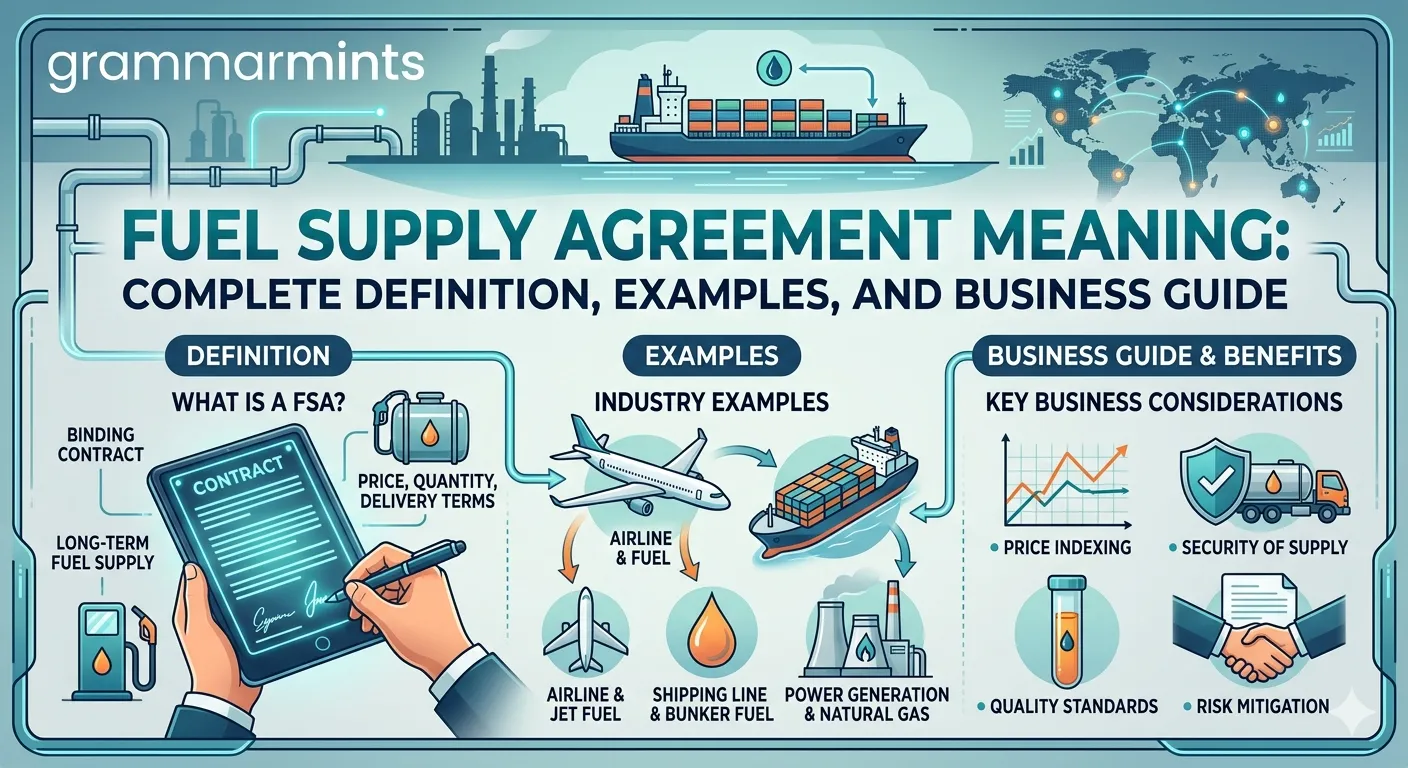
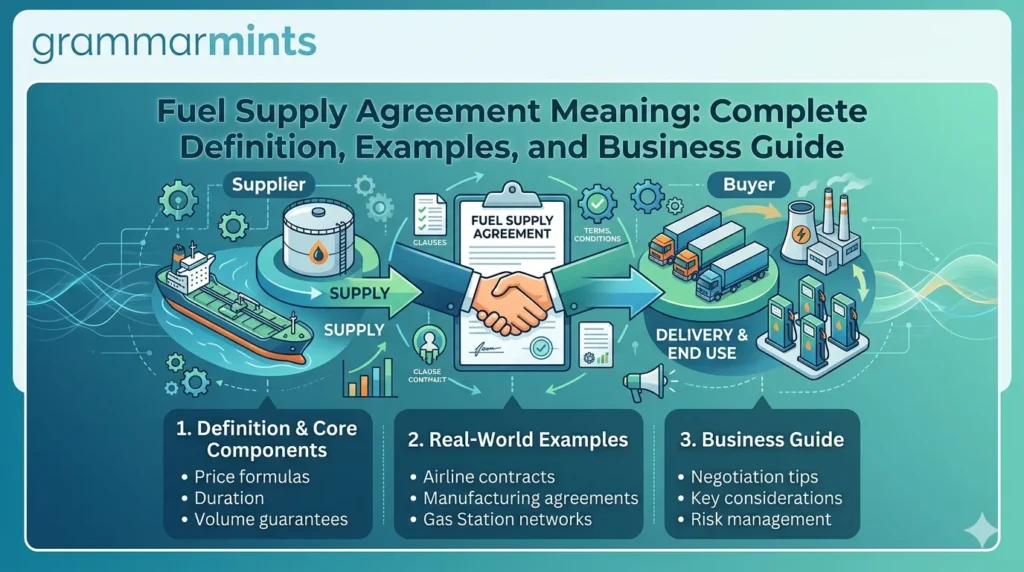
The fuel supply agreement meaning refers to a formal contract between a fuel supplier and a customer. Under this arrangement, one party agrees to provide fuel, while the other agrees to purchase it under specific terms.
In most business settings, fuel plays a critical role in daily operations. Therefore, companies often use these agreements to secure reliable fuel deliveries. As a result, both parties gain greater certainty regarding pricing, supply schedules, and responsibilities.
Although the phrase sounds technical, its basic meaning is easy to understand. Simply put, it is a contract that explains how fuel will be bought, supplied, delivered, and paid for.
Quick Definition
A fuel supply agreement is a legally binding contract that sets the rules for ongoing fuel purchases and deliveries.
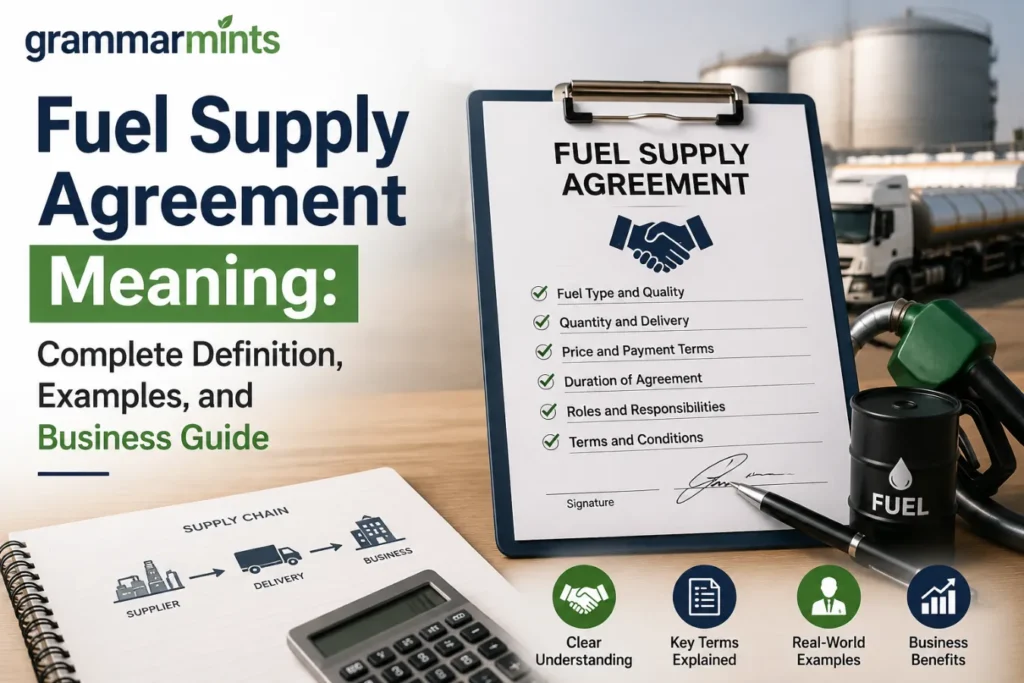
More specifically, it outlines fuel quantities, delivery schedules, pricing methods, payment terms, and contract duration. Consequently, both parties know exactly what is expected throughout the agreement period.
Why Fuel Supply Agreements Are Important
Many businesses cannot operate without a steady fuel supply. For that reason, a formal agreement helps reduce uncertainty.
For example, trucking companies require diesel every day. Similarly, airlines depend on aviation fuel before every flight. Meanwhile, manufacturing plants need fuel to power equipment and machinery.
Without a reliable fuel source, operations may slow down or stop entirely. Therefore, companies often view fuel supply agreements as essential business documents.
Furthermore, these contracts help organizations plan future expenses more accurately.
Fuel Supply Agreement Meaning in Plain English
In plain English, a fuel supply agreement is a written promise between a fuel seller and a fuel buyer.
Instead of relying on verbal arrangements, both sides document their obligations. Consequently, misunderstandings become less likely.
A typical agreement answers important questions such as:
• What type of fuel will be supplied?
• How much fuel will be delivered?
• When will deliveries occur?
• How will pricing be calculated?
• What payment terms apply?
Because these details appear in writing, both parties can refer to the contract whenever questions arise.
Part of Speech
From a grammar perspective, fuel supply agreement functions as a noun phrase.
Rather than describing an action, the phrase identifies a specific type of contract.
Consider these examples:
• The company signed a fuel supply agreement.
• Management reviewed the fuel supply agreement yesterday.
• Our fuel supply agreement expires next year.
In each sentence, the phrase names a business document. Therefore, it acts as a noun phrase rather than a verb or adjective.
How a Fuel Supply Agreement Works
Before fuel deliveries begin, both parties negotiate contract terms. After negotiations conclude, they sign the agreement and establish a working relationship.
Next, the supplier delivers fuel according to the agreed schedule. Meanwhile, the customer makes payments according to the contract.
Throughout the agreement period, each side must fulfill its obligations. Consequently, operations can continue smoothly.
Although contract details vary, the overall process remains similar across industries.
Typical Process
- Determine fuel requirements.
- Select a supplier.
- Negotiate pricing and delivery terms.
- Review contract conditions.
- Sign the agreement.
- Begin fuel deliveries.
- Monitor contract performance.
As a result, both parties gain a structured framework for managing fuel transactions.
Common Components of a Fuel Supply Agreement
While every contract differs, several sections appear frequently.
Fuel Specifications
First, the agreement identifies the fuel type. Depending on the industry, this may include diesel, gasoline, aviation fuel, or marine fuel.
Additionally, quality standards often appear in this section. Therefore, buyers know exactly what product they will receive.
Quantity Requirements
Most agreements specify fuel volumes. For instance, a contract may require monthly or annual purchase commitments.
Furthermore, minimum and maximum supply levels may also be included.
Pricing Terms
Pricing provisions explain how fuel costs are calculated.
In some cases, contracts use fixed pricing. In other situations, pricing follows market indexes. Consequently, businesses can better understand future costs.
Delivery Conditions
Delivery sections describe where and when fuel will arrive.
Moreover, these provisions may address emergency deliveries and transportation responsibilities.
Industries That Commonly Use Fuel Supply Agreements
Many sectors rely heavily on fuel contracts.
Transportation companies represent one of the largest user groups. Because trucks consume significant fuel volumes, reliable supply remains essential.
Likewise, airlines frequently enter long-term fuel agreements. Similarly, shipping companies depend on marine fuel contracts.
In addition, manufacturing plants often use fuel supply agreements to maintain production schedules. Consequently, the term appears regularly in commercial operations.
Real-Life Example
Imagine a logistics company operating 300 trucks across several states.
To ensure uninterrupted service, the company signs a three-year fuel supply agreement with a regional distributor. Under the contract, diesel fuel arrives every week at designated locations.
Meanwhile, pricing follows a market-based formula. As a result, both parties understand their obligations from the beginning.
Because expectations remain clear, the business can focus on operations rather than fuel shortages.
Benefits of a Fuel Supply Agreement
Businesses often gain several advantages from these contracts.
Reliable Supply
First, agreements help secure fuel availability.
As a result, companies face fewer disruptions during normal operations.
Better Budget Planning
Pricing formulas create greater predictability.
Consequently, businesses can estimate future fuel expenses more accurately.
Reduced Disputes
Written terms reduce confusion.
Furthermore, documented obligations make it easier to resolve disagreements.
Stronger Business Relationships
Long-term contracts often encourage cooperation.
Therefore, suppliers and customers can develop stronger partnerships over time.
Common Mistakes People Make
Many people misunderstand the scope of these agreements.
One common mistake involves assuming the contract only addresses fuel prices. However, most agreements also cover deliveries, quality standards, payment terms, and responsibilities.
Another misunderstanding occurs when people treat every fuel purchase as a fuel supply agreement. In reality, a one-time purchase usually does not qualify.
Finally, some individuals believe all agreements contain identical terms. Nevertheless, each contract may include unique requirements.
Related Terms
Several related expressions appear in business discussions.
| Term | Meaning |
|---|---|
| Fuel Contract | General fuel-related contract |
| Supply Agreement | Contract for providing goods |
| Purchase Agreement | Contract focused on buying products |
| Fuel Procurement Contract | Contract for obtaining fuel |
| Energy Supply Agreement | Agreement covering energy resources |
Although these terms overlap, they are not always interchangeable.
Synonyms and Antonyms
Synonyms
The following phrases often have similar meanings:
• Fuel supply contract
• Fuel purchase agreement
• Fuel procurement agreement
• Commercial fuel contract
However, wording may vary by industry and jurisdiction.
Antonyms
There is no exact antonym for fuel supply agreement.
Nevertheless, contract termination, supply cancellation, or agreement expiration may represent the opposite business situation.
When to Use the Term
Use this phrase when discussing a formal fuel supply contract.
For example:
• The company renewed its fuel supply agreement.
• Lawyers reviewed the fuel supply agreement before signing.
• Management approved a new fuel supply agreement.
In professional communication, this term provides greater precision than casual alternatives.
When Not to Use the Term
Not every fuel transaction requires this phrase.
For instance, purchasing gasoline at a service station is generally a simple retail transaction. Likewise, a fuel receipt does not create an ongoing contractual relationship.
Instead, the term usually refers to a structured agreement involving continuing obligations.
Frequently Asked Questions
What is a fuel supply agreement?
A fuel supply agreement is a contract that outlines how fuel will be supplied, delivered, priced, and paid for.
Is a fuel supply agreement legally binding?
Yes. Once signed, the agreement generally becomes legally enforceable under applicable laws.
Who uses fuel supply agreements?
Transportation companies, manufacturers, airlines, shipping firms, and government organizations commonly use them.
How long do fuel supply agreements last?
Contract durations vary considerably. Some agreements last several months, while others remain active for multiple years.
Can fuel prices change during the contract?
Yes. Many agreements include pricing formulas that adjust according to market conditions.
What happens if fuel deliveries are interrupted?
Most contracts include provisions explaining responsibilities, remedies, and exceptions.
Conclusion
Understanding the fuel supply agreement meaning helps you interpret business contracts with greater confidence. Moreover, knowing how these agreements work can improve decision-making when evaluating fuel purchasing arrangements.
Whether you work in transportation, manufacturing, aviation, or construction, a fuel supply agreement provides structure, clarity, and predictability. Therefore, reviewing the contract carefully before signing remains an important step.