You may have seen the word anagram in crossword puzzles, word games, classrooms, or language lessons. Although the term looks technical at first, the idea behind it is simple.
Anagrams involve rearranging letters to create a new word or phrase. Because they combine language and problem-solving, they are popular in puzzles and educational activities.
This guide explains what an anagram means, how it works, where people use it, and how to recognize one correctly. In addition, you will find examples, common mistakes, and answers to frequently asked questions.
Quick Answer
Anagram meaning refers to a word or phrase formed by rearranging the letters of another word or phrase.
For example, rescue and secure are anagrams because they contain the same letters in a different order.
TL;DR
• An anagram rearranges letters into a new word.
• All original letters must be used.
• Anagrams appear in puzzles and games.
• They can involve words or phrases.
• Anagram is mainly a noun.
• Letter order changes, but letters stay the same.
What Does Anagram Mean?
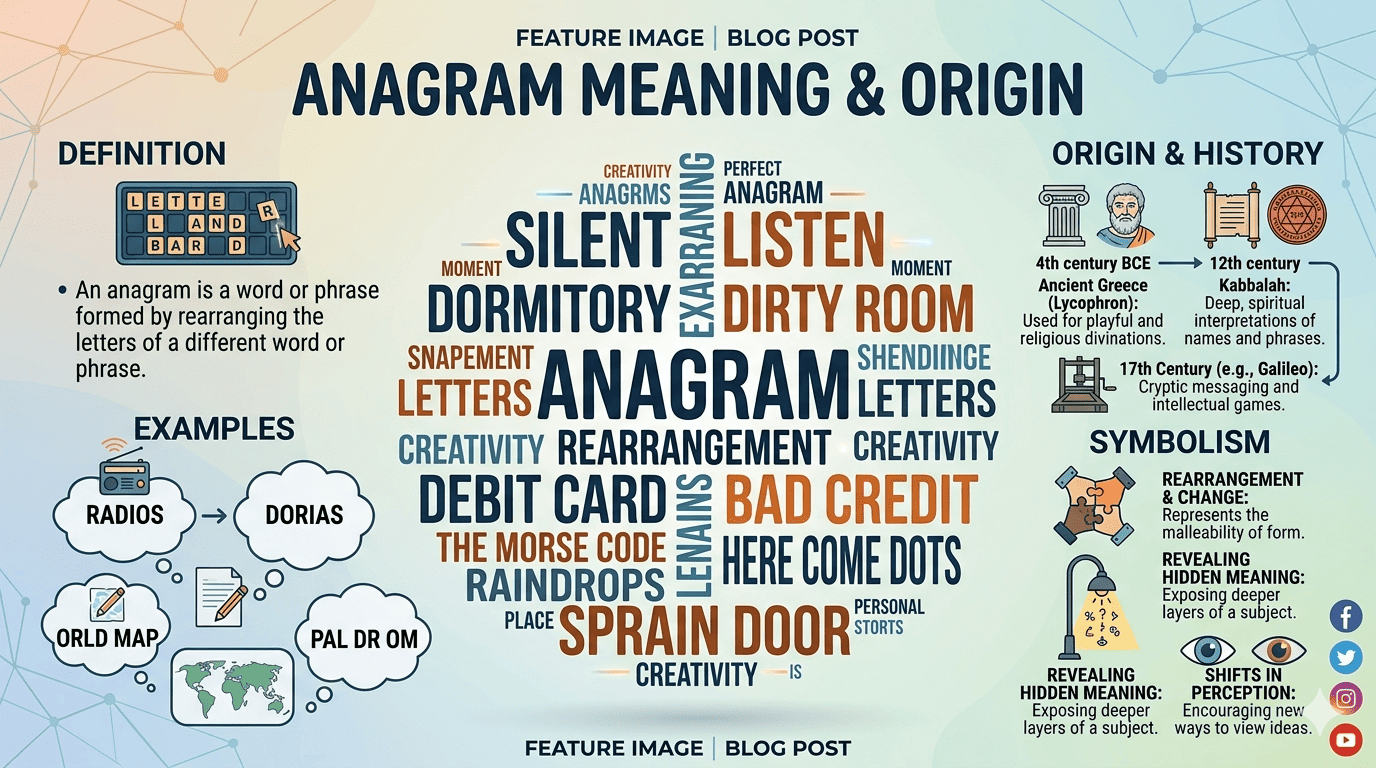
An anagram is a word or phrase created by changing the order of letters in another word or phrase.
Importantly, no letters are added or removed. Instead, the same letters are simply rearranged.
For example:
• listen → silent
• rescue → secure
• earth → heart
Each pair contains exactly the same letters.
Definition in Plain English
In plain English, an anagram is:
A new word made from the same letters.
Think of it as taking letter pieces and moving them into a different arrangement.
For instance, the letters in angel can be rearranged to form glean.
Therefore, both words are anagrams of each other.
Pronunciation of Anagram
The word anagram is commonly pronounced:
ANuhgram
Simple pronunciation guide:
/ˈæn.ə.ɡræm/
Many learners place too much stress on the second syllable. However, the strongest stress is usually on the first syllable.
Part of Speech
Anagram is primarily a noun.
Example:
“Silent is an anagram of listen.”
Less commonly, it can also be used as a verb.
Example:
“She anagrammed the word to create a puzzle.”
In everyday English, the noun form is far more common.
How Anagrams Work
Every original letter must appear in the new arrangement.
For example:
Listen
Letters:
L I S T E N
Rearranged:
S I L E N T
Because the letters remain identical, the new word is a true anagram.
Quick Comparison
| Context | Best Choice | Why |
|---|---|---|
| Same letters, new order | Anagram | Correct definition |
| Random mixed letters | Word scramble | May not form a real word |
| Different letters added | Not an anagram | Rule is broken |
Common Examples of Anagrams
Many English words have anagrams.
Examples include:
• listen → silent
• earth → heart
• angel → glean
• secure → rescue
• alert → later
Phrase anagrams also exist.
Example:
• dormitory dirty room
These examples show how the same letters can create entirely different meanings.
Where People See Anagrams
Anagrams appear in many places.
For example, they are common in:
• Crossword puzzles
• Word games
• Classroom activities
• Brain teasers
• Language-learning exercises
Additionally, some writers use anagrams for character names or hidden messages.
Because of this, anagrams are often associated with creativity and wordplay.
Origin and History of Anagrams
The term comes from ancient Greek roots related to rearranging letters. Historical records show that anagrams have been used for centuries.
Throughout history, writers, scholars, and puzzle creators have enjoyed making anagrams.
Today, they remain popular in educational games and recreational puzzles.
Related Terms, Synonyms, and Antonyms
Close related terms include:
• Wordplay
• Letter puzzle
• Word rearrangement
• Word game
There is no exact synonym for anagram.
Likewise, there is no widely accepted antonym.
As a result, most dictionaries describe anagrams using definitions rather than opposites.
Common Mistakes
Mistake 1: Adding Extra Letters
Incorrect:
listen → silently
This is not an anagram because extra letters were added.
Correct:
listen → silent
Mistake 2: Leaving Out Letters
Every letter must be used.
Otherwise, the result is not a true anagram.
Mistake 3: Confusing Anagrams with Scrambles
A word scramble may not create a valid word.
By contrast, an anagram normally forms another real word or phrase.
FAQ
What is an anagram?
An anagram is a word or phrase formed by rearranging the letters of another word or phrase.
What is an example of an anagram?
A common example is listen and silent. Both use the same letters.
Can phrases be anagrams?
Yes. Entire phrases can be rearranged into new phrases while keeping the same letters.
Are anagrams used in puzzles?
Yes. Crossword puzzles, word games, and brain teasers frequently use anagrams.
How do you make an anagram?
Start with a word and rearrange its letters. Then check that every original letter is still present.
Is an anagram a grammar term?
No. An anagram is a wordplay and vocabulary concept rather than a grammar rule.
Mini Quiz
1. Which pair is an anagram?
A. listen – silent
B. book – books
2. Must all letters be used?
A. Yes
B. No
3. Is “earth” an anagram of “heart”?
A. Yes
B. No
4. Can phrases be anagrams?
A. Yes
B. No
Answer Key
- A
- A
- A
- A
Conclusion
The mean anagram topic centers on a simple idea: rearranging letters to create a new word or phrase. Although the concept is easy to learn, it can lead to creative puzzles and interesting language activities.
Now that you understand what an anagram is, try finding a few examples in your own vocabulary.