You may come across the phrase direct earnings attachment in payroll records, government letters, or financial documents. At first glance, the term can seem confusing because it sounds highly technical. However, the basic idea is fairly simple.
In many cases, official documents use specialized language that is unfamiliar to the average reader. As a result, people often search for the direct earnings attachment meaning when they receive a notice or read a payroll document. This guide explains the phrase in plain English. Additionally, it covers pronunciation, examples, common contexts, related terms, and frequently asked questions.
Quick Answer
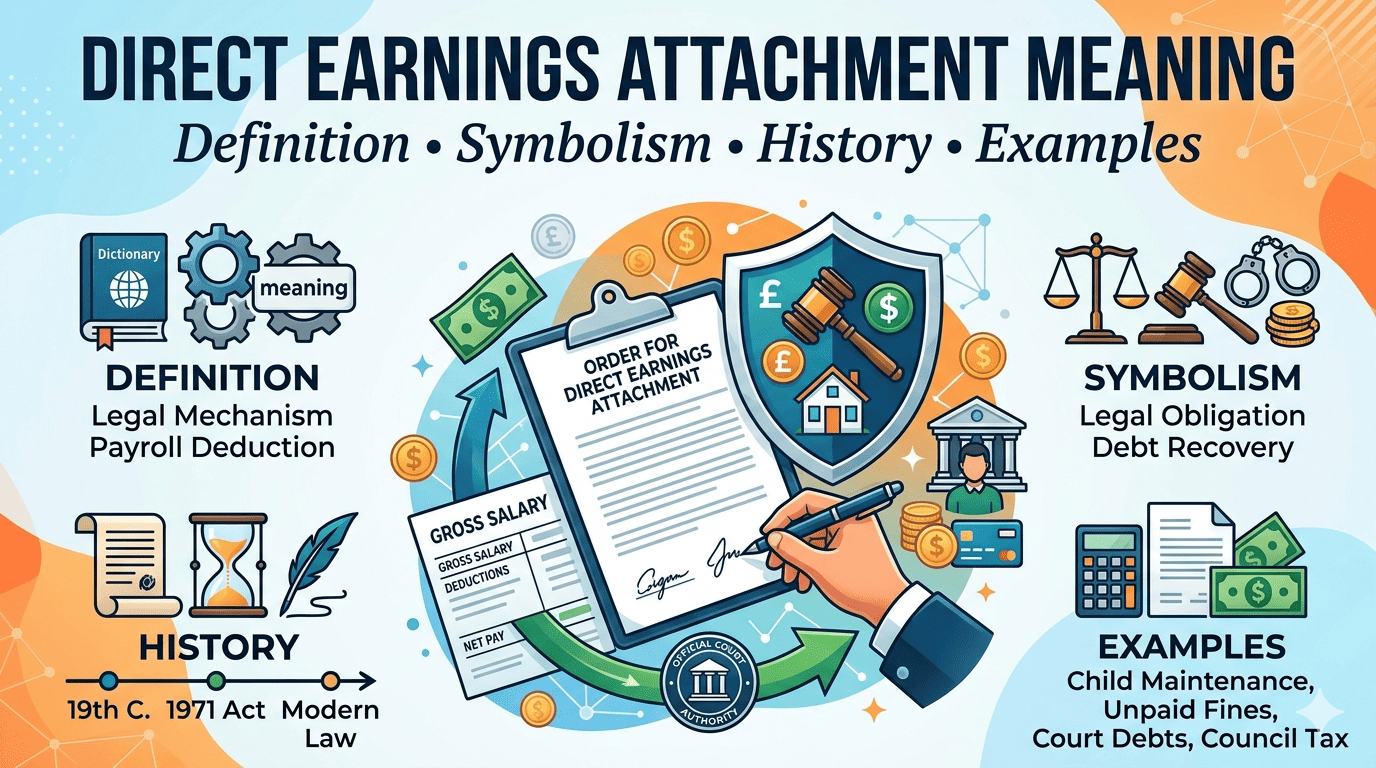
The direct earnings attachment meaning refers to a legal process that allows an employer to deduct money directly from an employee’s wages to repay a debt. Instead of making separate payments, the employee repays the debt through payroll deductions.
TL;DR
• A direct earnings attachment is a wage deduction.
• Employers take money from earnings to repay debt.
• The phrase is mainly used in the United Kingdom.
• Many organizations shorten it to DEA.
• Payroll and government documents often contain the term.
What Does Direct Earnings Attachment Mean?
In plain English, a direct earnings attachment allows an employer to remove a portion of a worker’s earnings before issuing full pay.
As a result, part of the employee’s wages goes toward repaying an outstanding debt. Rather than arranging separate payments, the employee contributes through automatic payroll deductions. Consequently, the repayment process becomes more organized and consistent.
Although the phrase sounds formal, it simply describes a method of collecting debt through wage deductions.
Definition in Plain English
A direct earnings attachment is:
A legal deduction taken from an employee’s earnings to repay a debt.
Unlike ordinary payroll deductions, this arrangement follows specific legal procedures. Therefore, employers must process the deduction according to official requirements.
Meaning in English
For most readers, the phrase means that someone owes money and repays it through deductions from their wages.
While the wording may appear complicated, the concept remains straightforward. A payroll department deducts money from earnings and forwards it toward debt repayment. Because of this arrangement, the employee receives a reduced take-home payment until the balance is cleared.
Pronunciation
Most speakers pronounce the phrase like this:
duh-REKT UR-ningz uh-TACH-muhnt
Meanwhile, many organizations use the abbreviation DEA in official documents.
In conversation, some people prefer the abbreviation because it is easier and faster to say. Nevertheless, official documents may use either the abbreviation or the complete phrase.
Part of Speech
Direct earnings attachment functions as a noun phrase.
Because the phrase names a specific process, writers use it as a noun. Furthermore, the expression identifies a legal arrangement rather than an action.
Examples include:
• The employer received a direct earnings attachment notice.
• Payroll staff processed the direct earnings attachment.
• An employee questioned the direct earnings attachment deduction.
By contrast, the phrase does not function as a verb, adjective, or adverb.
How the Phrase Is Used
Generally, people encounter this term in formal settings.
For instance, payroll departments may include it in employment records. Likewise, government agencies often mention it in official correspondence. In addition, financial organizations may reference the process when discussing repayment arrangements.
Common places where the phrase appears include:
• Payroll records
• Employer notices
• Government letters
• Debt repayment communications
• Financial documents
Meanwhile, casual conversations rarely include this expression because it belongs primarily to administrative and legal contexts.
Common Contexts
The phrase often appears in situations involving employment and debt repayment.
For example, an employer may receive instructions regarding deductions. Similarly, a government department may send a notice explaining the process. In both situations, the phrase refers to the same arrangement.
| Context | Meaning |
|---|---|
| Payroll | Deduction from wages |
| Government notice | Debt recovery process |
| Employment records | Earnings deduction |
| Financial correspondence | Repayment arrangement |
Examples of Direct Earnings Attachment
The following examples demonstrate how people use the phrase:
• The employer received a direct earnings attachment notice.
• Payroll staff explained the deduction process.
• A direct earnings attachment reduced her monthly take-home pay.
• After reviewing the notice, the employee contacted payroll for clarification.
• Meanwhile, the organization continued collecting the debt through deductions.
• Later, government officials sent a follow-up letter regarding repayment.
As these examples show, the phrase usually appears in employment and financial situations.
Related Terms
Several expressions share a similar meaning.
For example, people frequently mention wage deductions and payroll deductions in related discussions. However, each term may carry a different legal meaning. Furthermore, some expressions apply only in specific countries.
Related terms include:
• Wage deduction
• Earnings deduction
• Payroll deduction
• Wage garnishment
• Debt recovery
Synonyms and Antonyms
No exact synonym exists because the phrase describes a specific legal process.
However, several expressions have similar meanings:
• Wage deduction
• Earnings deduction
• Payroll withholding
• Wage garnishment
On the other hand, no true antonym exists. Even so, people sometimes use opposite ideas such as:
• Full wage payment
• No payroll deductions
Common Mistakes
Thinking It Is a Tax
Many readers assume the phrase refers to taxation. In reality, a direct earnings attachment helps recover a debt rather than collect taxes.
Treating It as Informal Language
Some people believe the phrase belongs to everyday speech. However, employers, payroll departments, and government agencies use it as a formal administrative term.
Confusing It With Every Payroll Deduction
Not every paycheck deduction qualifies as a direct earnings attachment. Instead, the phrase refers to a specific legal arrangement.
When to Use the Term
Use the phrase when discussing an official debt-recovery process.
For example, payroll professionals may include it in workplace communications. Similarly, government departments often use it in notices and repayment documents. Therefore, the term works best in formal employment and financial contexts.
Avoid using the phrase as a general label for every paycheck deduction because it has a specific meaning.
Frequently Asked Questions
What does direct earnings attachment mean?
The phrase refers to a legal process that allows an employer to deduct money from wages to repay a debt.
What does DEA stand for?
DEA stands for Direct Earnings Attachment.
Is direct earnings attachment a legal term?
Yes. Employers, payroll departments, and government organizations use it as a formal legal term.
Is the phrase common in American English?
Not usually. Instead, the phrase appears more frequently in British employment and payroll contexts.
Who makes the deduction?
The employer makes the deduction through payroll and forwards the money to the appropriate organization.
Is direct earnings attachment slang?
No. In fact, it is a formal administrative and legal expression.
Mini Quiz
1. What does DEA stand for?
Answer: Direct Earnings Attachment.
2. What type of phrase is it?
Answer: A noun phrase.
3. Where do people commonly see it?
Answer: Payroll and government documents.
4. Is it formal or informal?
Answer: Formal.
5. Does it relate to debt repayment?
Answer: Yes.
Conclusion
The direct earnings attachment meaning refers to a legal process that allows employers to deduct money from wages to repay a debt. Although the phrase may sound complex at first, the concept is relatively simple. By understanding the term, you can read payroll documents more confidently. Furthermore, you can better understand official notices and financial correspondence in the future. Finally, recognizing the phrase helps you interpret employment-related documents with greater ease.