Have you ever read your own paragraph back and lost track of where one idea ends and the next begins? That tangled feeling usually comes from two small grammar problems: run on sentences and fragments. Both errors are common, and both are fixable once you know what to look for. This guide walks you through clear examples, quick fixes, and simple habits so your writing reads smoothly for readers in the US and Europe alike.
Parallel Structure in Sentences: Rules and Examples You Can Use Today
TL;DR: Run-on sentences and fragments happen when clauses are joined incorrectly or left incomplete. You can fix most of them with a period, a comma plus a conjunction, a semicolon, or by adding the missing subject or verb. Reading your sentences aloud is the fastest way to catch both problems before you hit publish.
What Is a Prepositional Phrase? Core Rules, Examples, and Exercises
What Are Run-On Sentences and Fragments, Really?
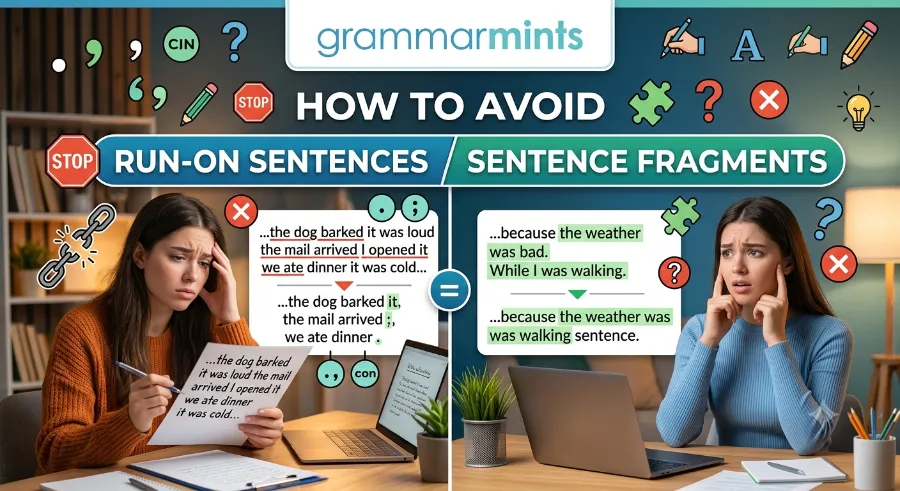
A run-on sentence happens when two complete thoughts get crammed together without the right punctuation or connecting word. A fragment is the opposite problem: it’s a piece of a sentence pretending to be a whole one. Neither error means you’re a bad writer. In fact, the Sweetland Center for Writing at the University of Michigan notes that these are three of the most common sentence-building errors, ones most people can sense are wrong even before they know what to call them.
How to Avoid Run-On Sentences and Sentence Fragments
Once you understand the mechanics, though, spotting these issues gets much easier. Therefore, we’ll break each one down separately before looking at how to fix them.
Sentence Fragment Examples You’ll Recognize
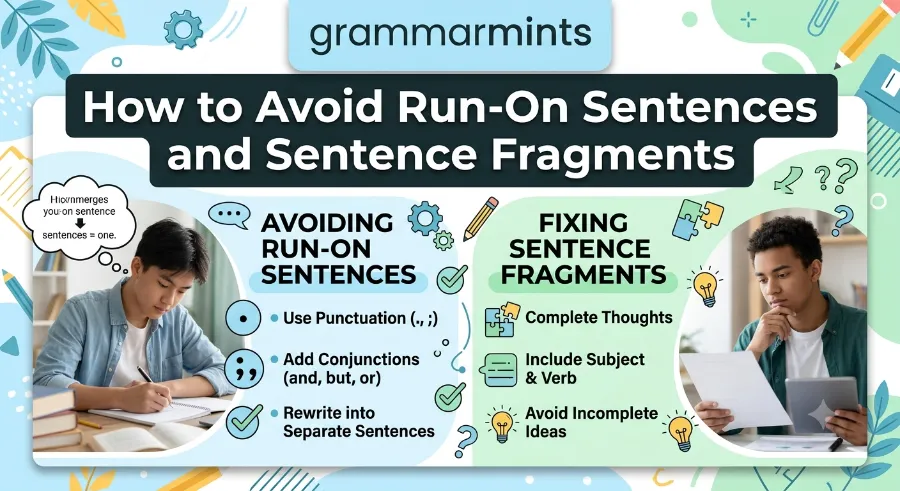
A fragment is missing a subject, a verb, or a complete thought. For instance, “Running late for the meeting” is not a sentence. It has no subject and no main verb doing the work.
Here are a few more sentence fragment examples pulled from everyday writing:
- “Because the client changed the deadline.” (starts with a dependent word, never finishes the thought)
- “Walking through the old part of town.” (no subject, no complete action)
- “Which made the whole team nervous.” (a dependent clause left standing alone)
Each one leaves the reader hanging. As the Sweetland guide explains, a fragment usually happens when a dependent clause gets used as if it were a full sentence on its own. The fix is simple: attach it to an independent clause that completes the thought.
Comma Splice Examples and Why They Trip Writers Up
A comma splice is a specific type of run-on. It happens when two complete sentences are joined by only a comma, with no conjunction to hold them together.
Consider this line: “The report was due Friday, the team submitted it a day early.” Both halves could stand on their own as full sentences. Because a comma alone can’t do that job, this is a classic comma splice.
Sentence Variety Techniques: How to Mix Short and Long Sentences
Another common comma splice example shows up with words like however and therefore. Writers often assume these words work like and or but, but they don’t function the same way in a sentence. According to the Touro University Writing Center, this specific kind of comma splice is one of the most frequent slip-ups writers make, especially when a transitional word like “therefore” is treated as a connector instead of the start of its own clause.
How to Fix Run-On Sentences: 5 Reliable Methods
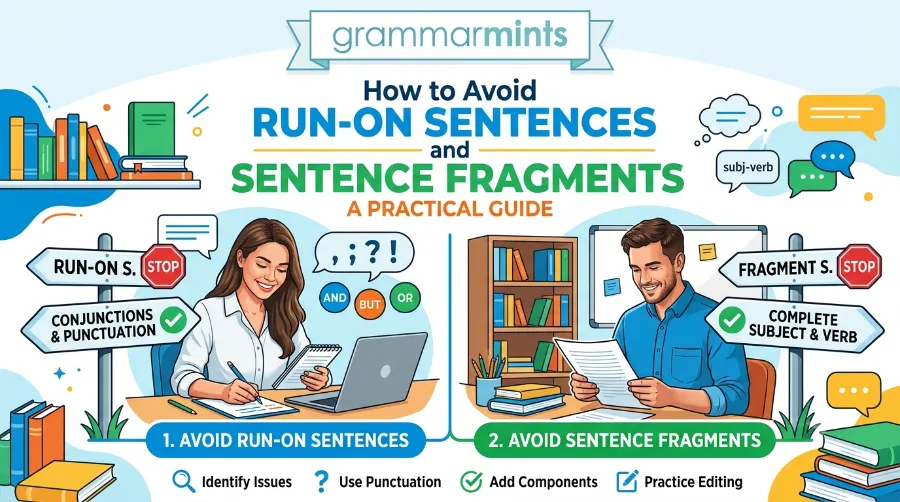
Once you can spot the problem, fixing it takes seconds. Below are five dependable ways to learn how to fix run-on sentences, whether you’re drafting an email, an essay, or a blog post.
- Split it with a period. This is the simplest option. Break the run-on into two separate sentences wherever the first complete thought ends.
- Add a comma and a coordinating conjunction. Words like and, but, or, and so can join two full sentences correctly when paired with a comma.
- Use a semicolon. A semicolon links two closely related independent clauses without needing a conjunction at all.
- Turn one clause into a dependent clause. Adding a word like because, although, or since to the start of one clause makes it lean on the other, which resolves the run-on.
- Rewrite the sentence entirely. Sometimes the cleanest fix is to restructure the whole idea rather than patch it.
-
Transition Words List: How to Use Transition Words to Connect Sentences
The Sweetland writing guide backs up this same approach, listing a period, a coordinating conjunction, a dependent conjunction, a semicolon, or a full rewrite as the standard ways to correct a comma splice. Consequently, these five tools cover almost every run-on you’ll ever meet, whether it’s a comma splice or a fully fused sentence with no punctuation at all.
Dangling and Misplaced Modifiers: How to Fix Them (With Real Examples)
Here’s a before-and-after table that shows each method in action:
| Method | Original Run-On | Fixed Version |
|---|---|---|
| Period | I finished the draft I sent it to my editor. | I finished the draft. I sent it to my editor. |
| Comma + conjunction | Sales rose in Q2, the team hadn’t expected it. | Sales rose in Q2, but the team hadn’t expected it. |
| Semicolon | The flight was delayed we waited three hours. | The flight was delayed; we waited three hours. |
| Dependent clause | The budget was tight we still hit our targets. | Although the budget was tight, we still hit our targets. |
| Rewrite | The meeting ran long everyone left frustrated. | The overly long meeting left everyone frustrated. |
Real Examples From Real Writing
Grammar rules feel abstract until you see them in context. A 2023 internal audit at a mid-sized marketing agency in Chicago found that nearly 4 in 10 first-draft blog posts submitted by junior writers contained at least one run-on sentence in the opening paragraph alone. That single stat became the reason the agency added a five-minute “read aloud” step before every draft moved to editing, and error rates in that first paragraph dropped by roughly half within two months.
How to Write Clear Sentences (Without Losing Your Reader)
A high school English teacher in Manchester, UK, shared a similar pattern in 2022: on a batch of 30 timed essays, 22 students had written at least one fragment, most often right after a semicolon or a dash was used incorrectly. Her fix was simple. She asked students to underline every sentence that started with because, although, or which and check whether it could stand alone. Scores on the following assignment improved noticeably, mostly because students were catching their own fragments before submission.
These examples matter because they show the pattern is universal. Whether you’re writing marketing copy, an academic essay, or a quick email, the same two habits, reading aloud and checking each clause, catch most problems before a reader ever sees them.
Common Situations Where These Errors Sneak In
Certain writing situations invite run-ons and fragments more than others. Recognizing these moments in advance helps you slow down exactly when it counts.
- Fast-typed emails. When you’re rushing, clauses often get stapled together without punctuation.
- Long explanations. The more ideas you try to pack into one sentence, the higher the odds of a run-on.
- Stylistic fragments. Some writers use fragments on purpose for emphasis, which is fine in casual blog writing but risky in formal reports.
- Transitional words mid-sentence. Words like however, therefore, and meanwhile often get treated like simple conjunctions, and that’s where comma splices creep in.
-
Sentence Combining Techniques for Smoother Writing
If you notice your writing tends to fall into one of these traps, build a short pause into your process. Even 60 seconds of rereading a paragraph out loud can catch what your eyes tend to skip.
A Simple Editing Checklist
Before you publish or submit anything, run through this short list. It takes less than five minutes for a typical blog post or essay.
- Read each paragraph aloud, one sentence at a time.
- Underline every comma that connects two full sentences, then check if a conjunction is missing.
- Circle any sentence that starts with because, although, which, or since and confirm it isn’t standing alone.
- Search for repeated transitional words like however and therefore, then check the punctuation around them.
- Read the piece backward, sentence by sentence, to isolate each one from the flow of the paragraph.
This process works well alongside a broader review of your sentence structure, since run-ons and fragments are really just two sides of the same structural issue. If you also want a refresher on how different sentence types are built in the first place, this guide on types of sentences in English pairs well with the fixes above.
Why This Skill Matters Beyond the Classroom
Clear sentences aren’t just an academic requirement. Recruiters, editors, and readers all form quick judgments based on how cleanly a piece of writing flows. A 2021 survey by the National Association of Colleges and Employers found that written communication consistently ranks among the top skills employers look for in new graduates across the US and Europe.
Poor sentence structure can also hurt search visibility. Long, tangled sentences increase reading difficulty scores, and search engines increasingly favor content that’s easy to scan. So the payoff for fixing run-ons and fragments isn’t just cleaner prose; it’s better comprehension, better engagement, and often better rankings too.
For a deeper dive into related grammar habits, you can browse more guides on the Grammar Mints homepage, where several related lessons cover punctuation, clause structure, and common writing mistakes side by side. Additional practice worksheets are also available from independent education resources such as this collection of exercises on fragments and run-ons, which many teachers use for extra classroom practice.
Frequently Asked Questions
What is the fastest way to tell if a sentence is a run-on? Try splitting it at the point where a new subject appears. If both halves can stand alone as complete sentences with no connecting word or punctuation between them, it’s a run-on.
Are sentence fragments always wrong? Not always. Skilled writers sometimes use short fragments for emphasis in casual or creative writing. However, in academic or professional writing, fragments are usually flagged as errors.
What’s the difference between a run-on sentence and a comma splice? A comma splice is one specific type of run-on. It happens when a comma alone joins two complete sentences, while a true run-on may have no punctuation between the clauses at all.
Can grammar checking tools catch every run-on or fragment? Most tools catch obvious cases, but they often miss fragments used for stylistic effect or comma splices involving transitional words like however. Reading your work aloud still catches errors that software sometimes misses.
How many run-on sentences is too many in one piece of writing? There’s no fixed number, but if a reader has to reread a sentence to understand it, that’s one too many. Aim for zero in formal writing and use judgment in casual pieces.
Conclusion
Run-on sentences and fragments are two of the most common, and most fixable, problems in everyday writing. Once you learn to spot a dependent clause standing alone or two full sentences jammed together, the fixes become almost automatic. Reading aloud, checking your transitional words, and running through a short editing checklist will catch most issues before anyone else ever sees them. With a little practice, clear and complete sentences become second nature rather than a constant struggle.
References
- Sweetland Center for Writing, University of Michigan. “Sentence Fragments, Comma Splices, and Run-ons.” https://lsa.umich.edu/sweetland/undergraduates/writing-guides/sentence-fragments-comma-splices-run-ons.html
- Touro University Writing Center. “Run-on Sentences/Sentence Fragments.” https://www.touro.edu/departments/writing-center/tutorials/run-on-sentencessentence-fragments/
- Robin B. Neal. “Fragments, Run-ons, and Sentences: Resources for Students.” https://robinbneal.com/2016/02/09/fragments-run-ons-and-sentences-resources-for-students/
- National Association of Colleges and Employers, Job Outlook Survey, 2021.