
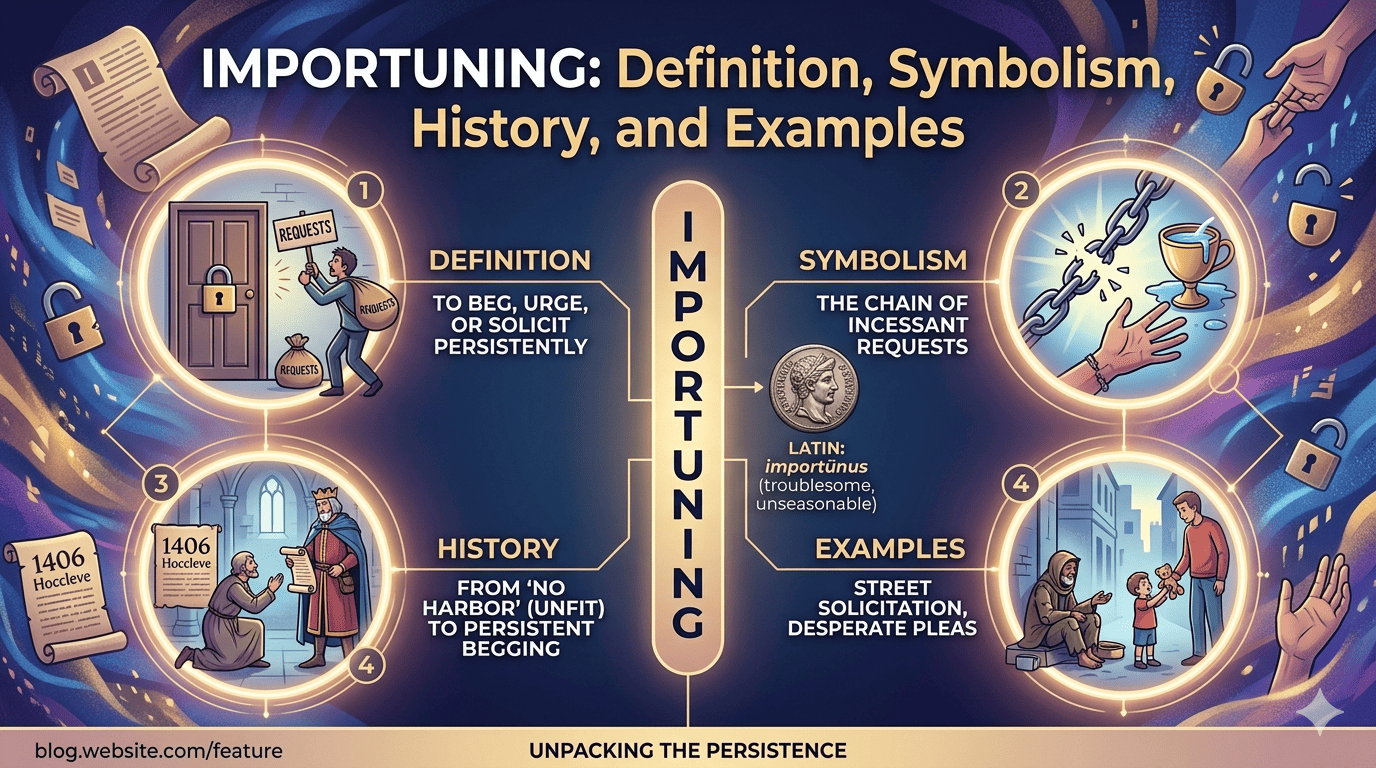
Have you ever seen the word importuning and wondered what it means? Although the term is less common than words like asking or begging, it still appears in books, articles, and legal discussions.
At first, the word may seem difficult. However, its basic meaning is quite simple. In general, importuning refers to making repeated requests. Because the requests continue over time, the word often suggests persistence. As a result, it may carry a slightly negative tone.
Today, many readers encounter this term while reading formal English. Therefore, understanding it can improve your vocabulary. In addition, it can help you understand the tone of a sentence more accurately. Throughout this guide, you’ll learn the definition, pronunciation, examples, and common uses of importuning.
Quick Answer
Importuning means repeatedly asking, urging, or requesting something from another person.
Usually, the requests continue after an initial answer. Consequently, the behavior may appear demanding or difficult to ignore.
What Does Importuning Mean?
Simply put, importuning means making persistent requests. Instead of asking once, a person continues to seek the same result.
In many situations, the word suggests pressure. Nevertheless, the request itself may be reasonable. Because persistence is the key idea, the focus remains on repeated appeals rather than a single question.
For example:
“The volunteer spent the afternoon importuning shoppers for donations.”
Here, the volunteer keeps making requests. Therefore, the sentence emphasizes ongoing effort.
Definition in Plain English
A plain-English definition is:
Importuning means repeatedly asking for something in a persistent or sometimes annoying way.
Generally, the word describes behavior that continues over time. Furthermore, it often involves an attempt to persuade someone. In contrast, a simple request usually happens only once.
Common situations include:
• Asking for help
• Seeking permission
• Requesting money
• Encouraging action
• Trying to gain approval
As a result, the word often appears when persistence becomes noticeable.
Pronunciation
Many learners are unsure how to pronounce importuning. Fortunately, the pronunciation is straightforward.
The word is pronounced:
im-por-TOON-ing
Phonetic spelling:
/ˌɪm.pɔːrˈtuː.nɪŋ/
Most importantly, the stress falls on the “toon” sound. Once you learn that pattern, the word becomes easier to remember.
Part of Speech
Most commonly, importuning functions as a verb form. Specifically, it is the present participle of the verb importune.
For example:
• “She was importuning her supervisor for approval.”
• “They were importuning local officials for assistance.”
Sometimes, however, the word can function as a noun. In that case, it refers to the act of making persistent requests.
Example:
“His constant importuning annoyed the committee.”

How Is Importuning Used?
Formal writing uses this word far more often than everyday speech. Therefore, readers usually encounter it in books, journalism, and professional writing.
A casual speaker might say:
“He kept asking me.”
By comparison, a formal writer may say:
“He was importuning me.”
Although both sentences communicate a similar idea, the second version sounds more formal. Consequently, it is often preferred in serious writing.
Common Contexts
Asking for Help
Sometimes people repeatedly seek assistance.
For instance:
“The traveler was importuning strangers for directions.”
Requesting Financial Support
In other situations, the word refers to repeated requests for money.
For example:
“Fundraisers were importuning visitors throughout the event.”
Seeking a Favor
Likewise, a person may continue asking for a favor.
Example:
“She kept importuning her friend to attend the concert.”
Trying to Gain Approval
Additionally, importuning may involve repeated efforts to obtain permission.
Example:
“Employees were importuning management for policy changes.”
Examples of Importuning in Sentences
To better understand the word, consider these examples:
• The salesman spent hours importuning potential customers.
• Meanwhile, reporters were importuning officials for answers.
• Despite several refusals, he continued importuning the committee.
• Eventually, everyone became tired of his constant importuning.
• Furthermore, the organization kept importuning supporters for donations.
• Consequently, some visitors decided to leave early.
• Later, staff members reduced their requests.
Synonyms and Antonyms
Synonyms
Several words share a related meaning.
These include:
• Begging
• Pleading
• Entreating
• Imploring
• Petitioning
• Soliciting
• Urging
• Pestering
However, each word has a slightly different tone. For example, imploring sounds emotional. By contrast, pestering sounds more irritating.
Antonyms
On the other hand, possible antonyms include:
• Refraining
• Accepting
• Withdrawing
• Ceasing
• Relenting
Even so, no antonym perfectly matches every use of importuning.
Importuning in Legal Contexts
Besides its everyday meaning, the word has appeared in legal language. Historically, some legal systems used importuning as a technical term.
Because legal definitions vary, the exact meaning depends on the jurisdiction. Therefore, readers should always consider context. Moreover, legal usage may differ from ordinary English. Consequently, understanding the setting is important.
| Context | Best Choice | Why |
|---|---|---|
| Everyday speech | Keep asking | Sounds natural |
| Formal writing | Importuning | More precise |
| Legal discussion | Importuning | May have technical meaning |
Common Mistakes
Using It for a Single Request
Many writers misuse the word for a one-time request.
Incorrect:
“She importuned him once.”
Better:
“She asked him once.”
Since importuning implies repetition, a single request does not usually fit.
Ignoring the Tone
Another mistake involves tone.
Although the word can be neutral, it often suggests annoyance. Therefore, writers should use it carefully.
Using It in Casual Speech
Most native speakers prefer simpler alternatives.
Instead, they often say:
• Kept asking
• Begged
• Pestered
• Urged
Related Words
Several related terms help clarify the meaning.
Importune
First, there is the verb importune.
Example:
“They tried to importune the mayor for support.”
Importunate
Next, the adjective importunate describes someone who is persistent.
Example:
“The importunate caller refused to stop calling.”
Importunity
Finally, importunity is a noun that means repeated requests.
Example:
“His importunity tested everyone’s patience.”
Frequently Asked Questions
Is importuning a negative word?
Generally, yes. However, the degree of negativity depends on context. Most often, the word suggests excessive persistence.
Is importuning formal or informal?
The term is mainly formal. Therefore, it appears more frequently in writing than in casual conversation.
What is the difference between begging and importuning?
Begging focuses on urgency. In contrast, importuning focuses on repeated requests.
Can importuning be used in legal writing?
Yes. In fact, some legal systems have used the term in a technical sense.
Is importuning still used today?
Although it is less common than simpler alternatives, it still appears in modern English.
Conclusion
Importuning means making repeated requests with persistence. Although the word is formal, it remains useful in literature, journalism, and professional writing.
As you continue building your vocabulary, you’ll recognize the term more easily. More importantly, you’ll understand the sense of ongoing pressure that the word often conveys.