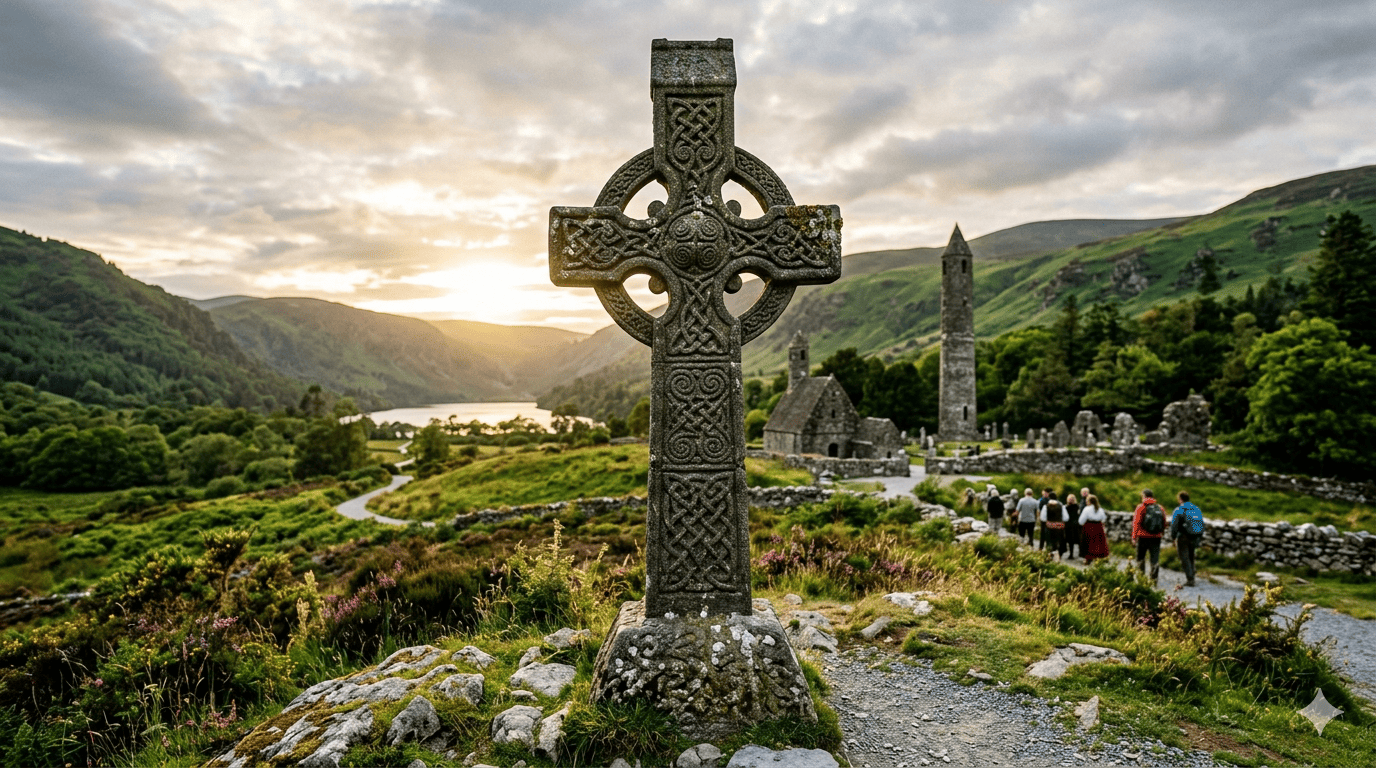
If you have ever admired an piece of Irish jewelry or looked closely at old stone monuments, you have likely run across an intricate geometric pattern known as the Celtic knot. These beautiful designs appear all over the world today on everything from wedding bands to modern body art. While they look highly decorative, these traditional shapes carry deep cultural weight.
Understanding what these patterns signify helps readers connect more deeply with global history and art. This article will walk you through the essential definitions, historical backgrounds, and varied meanings behind these ancient patterns. We will cover the core symbols, explore the most famous historical styles, and clear up common myths about their origins.
Quick Answer
A Celtic knot is a traditional decorative pattern featuring interwoven, continuous loops with no visible beginning or end. At its heart, the Celtic knot meaning centers on the concepts of eternity, interconnectedness, and the never-ending cycle of life.
TL;DR
- Core Meaning: Represents eternity, infinity, and the continuous cycle of life, death, and rebirth.
- Key Feature: Loops are unbroken and continuous, leaving no obvious start or finish.
- Origins: Flourished around the seventh century within early Christian art in Ireland and Britain.
- Popular Styles: Includes the Trinity Knot (Triquetra), Dara Knot, and Shield Knot.
- Modern Use: Frequently chosen today to signify eternal love, kinship, strength, and cultural pride.
What Is a Celtic Knot?
To understand this symbol, you must first look at its physical construction. A true Celtic knot is an example of interlace artwork. This means the lines form a ribbon that weaves over and under itself repeatedly.
The most distinguishing trait of these patterns is their closed nature. Instead of showing loose ends, the strands merge seamlessly. This unbroken geometry creates an infinite loop that naturally draws the human eye along a continuous path.
Meaning in Plain English
In simple terms, because you cannot find a starting point or an ending spot on a Celtic knot, it represents things that last forever. It serves as a visual metaphor for timeless concepts.
When people look at these loops, they think of ideas that have no boundaries. For instance, the design perfectly mirrors the way human lives, nature, and the spiritual world weave tightly together.
Core Themes and Symbolism
While individual styles carry unique messages, several overarching themes apply to almost all Celtic knotwork.
- Eternity and Continuity: The infinite loops represent an endless timeline. This can reference everlasting friendship, timeless love, or the continuous loop of human history.
- Interconnectedness: The tight weaves show that no element of life exists in total isolation. Everything fits together in universal harmony.
- Life Cycles: For many cultures, the pattern mirrors the cycle of birth, life, death, and eventual rebirth or afterlife.
Major Variations and Their Specific Meanings
Different shapes emphasize different aspects of human experience. Over the centuries, artists created specialized variations to highlight specific values.
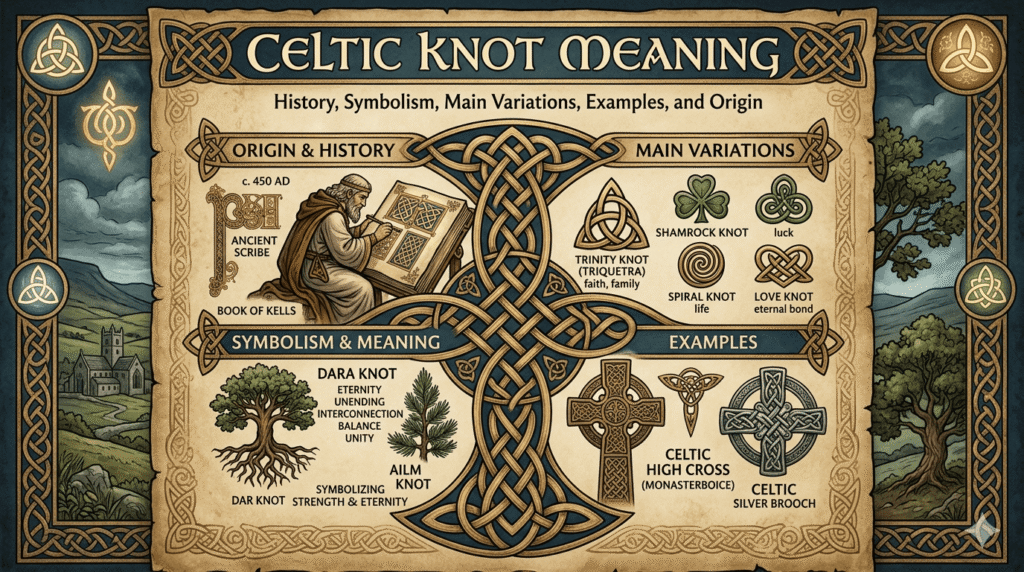
The Trinity Knot (Triquetra)
The word Triquetra comes from the Latin word for three-cornered. This three-pointed shape is arguably the most famous variation. For ancient pagan cultures, it likely represented the three domains of the earth: land, sea, and sky. It also mirrored the phases of time: past, present, and future. Later on, early Christian communities adopted the shape to represent the Holy Trinity.
The Dara Knot
The name Dara stems from the Irish word doire, which translates to oak tree. The intricate pattern of this design imitates the vast, tangled root system of a massive oak. Because oaks are famously durable, the Dara knot stands directly for inner strength, stability, and ancient wisdom.
The Shield Knot
As the name implies, the Shield Knot symbolizes protection, safety, and defense against harm. This variation features four distinct quadrants bound together by tight, heavy lines. Historically, soldiers etched this pattern into their battle shields to ward off injury and repel evil spirits.
Historical Origin and Evolution
The true history of the Celtic knot is often buried under popular romantic legends. While people often associate them exclusively with ancient pagan druids, history tells a slightly more nuanced story.
Interlaced designs actually appeared in Roman mosaics and ancient Mediterranean art before spreading northward. True Celtic knots, characterized by completely closed paths, reached their creative peak during the seventh and eighth centuries.
This style flourished inside Christian monasteries across Ireland, Scotland, and Northumbria. Monks used these gorgeous decorations to illuminate sacred religious texts. The most famous surviving example of this work is the Book of Kells, a beautifully decorated manuscript kept at Trinity College in Dublin.
The Technical Structure: How It Works
From a technical standpoint, historical artists did not just draw these freehand. They relied on geometric principles to lay out the patterns accurately.
Artists would first create a grid of evenly spaced dots. Then, they would draw diagonal lines between the dots, creating a woven framework. By systematically cutting certain strands and joining others together, they could transform a simple grid into a complex, looping masterpiece.
Modern Usage and Contexts
Today, Celtic knots remain highly popular visual symbols across the globe. Because they carry such positive connotations, people choose them for significant life moments.
Jewelry and Weddings
The concept of the “endless loop” makes this pattern a natural choice for romantic jewelry. Many modern couples choose Celtic bands for engagement rings or wedding stationery to pledge eternal devotion.
Tattoos and Personal Identity
People frequently choose these shapes for tattoos. For some, it serves as a proud nod to their ancestral Irish, Scottish, or Welsh heritage. For others, a design like the Dara knot offers a permanent reminder of personal resilience during difficult times.
Synonyms and Related Terms
If you are looking up this topic, you might encounter a few alternate terms. While they are closely related, they have slight differences in context.
- Interlace Art: The broad, academic term for any artistic style that features interwoven ribbons or bands.
- Insular Art: The specific historical art movement that blossomed in Ireland and Britain during the early Middle Ages.
- Irish Knot: A common, everyday term people use when referring specifically to knots with Irish historical ties.
Common Mistakes in Interpretation
The single biggest mistake people make is assuming every single twist and turn has an exact, documented ancient translation.
In reality, many detailed meanings were assigned to specific knots during the Celtic Revival of the nineteenth and twentieth centuries. While ancient people certainly valued the general concept of eternity, many specific definitions used today are modern interpretations. Understanding this helps you appreciate the art without falling for historical fiction.
FAQs
What does the Celtic knot mean?
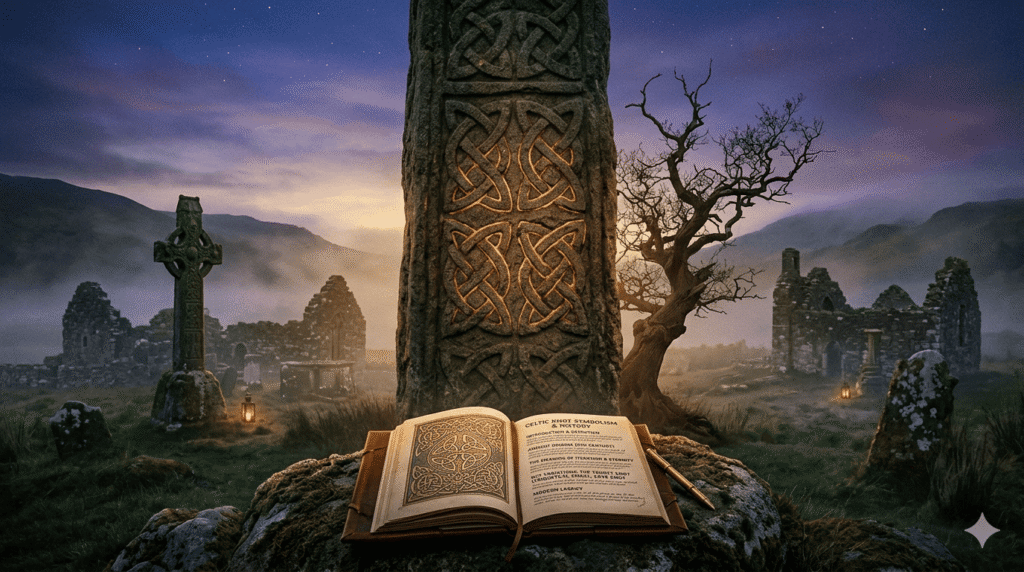
A Celtic knot generally means eternity, unity, and the cyclical nature of life. Its endless paths show that relationships, spirits, and time have no final ending point.
Did Celtic knots come from pagan or Christian roots?
The style developed from a mix of both worlds. While early geometric ideas existed in pre-Christian cultures, the true, closed Celtic knots were fully perfected by Christian monks in medieval monasteries.
What is the difference between an open and closed Celtic knot?
A closed knot features a single, unbroken line that represents infinity and eternity. An open knot features lines with distinct endings, which usually symbolizes a specific life journey or human path.
What does a four-cornered Celtic knot mean?
A four-cornered variation, often called a quaternary knot or shield knot, usually represents protection. It can also symbolize the four seasons, the four elements of nature, or the four cardinal directions.
Can a Celtic knot represent family?
Yes, many people use interwoven knots to represent family. The inseparable strands show the tight, unbreakable bonds that connect parents, children, and generations together.
Mini Quiz
Test your knowledge of Celtic knotwork with these simple questions.
- What is the defining physical feature of a true Celtic knot?
- Answer: It features continuous, interlaced loops with no visible beginning or end.
- Which famous historical manuscript features intricate Celtic knotwork?
- Answer: The Book of Kells.
- What does the word “Dara” mean in Irish, and what does its knot represent?
- Answer: It means “oak tree,” and the knot represents strength and wisdom.
Conclusion
The Celtic knot remains one of the world’s most enduring symbols of eternity, strength, and human connection. Whether you are studying history or choosing a meaningful gift, these ancient lines carry a timeless appeal. To learn more about historic symbols, try researching traditional Irish metalwork next.