
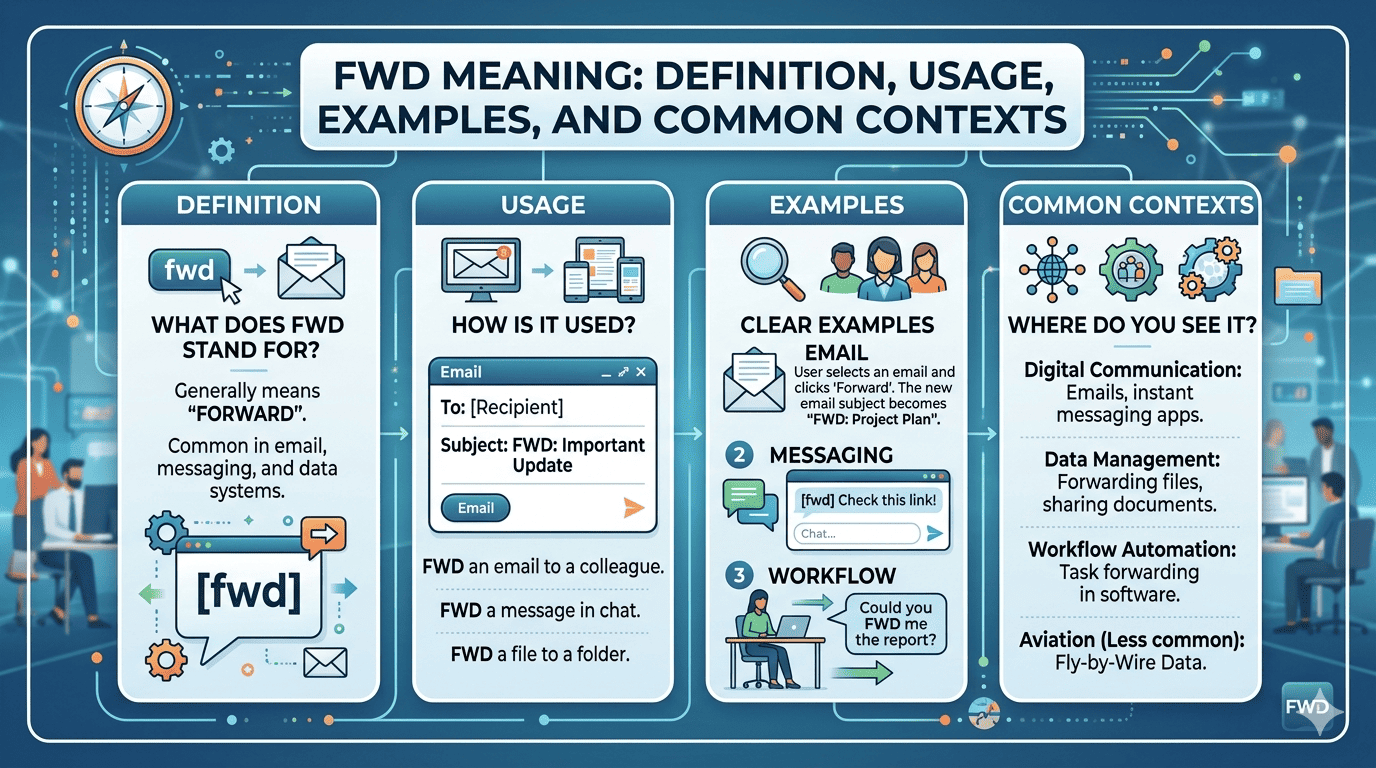
You may have seen the term FWD in emails, text messages, social media posts, or workplace communication. Although it looks simple, its meaning can vary slightly depending on the situation.
In most cases, FWD is an abbreviation for “forward” or “forwarded.” It tells readers that a message, email, document, or piece of information has been sent from one person to another.
Because digital communication is part of everyday life, understanding FWD can help you read messages more accurately and communicate more effectively. This guide explains what FWD means, how people use it, and where you are most likely to encounter it.
Quick Answer
FWD meaning is usually “forward” or “forwarded.” It indicates that a message, email, link, image, or document has been passed from one person to another.
TL;DR
• FWD usually means “forward” or “forwarded.”
• It commonly appears in email subject lines.
• It shows that content was shared again.
• It is widely used online and at work.
• FWD is an abbreviation, not a slang word.
• Context helps determine the exact meaning.
What Does FWD Mean?
FWD is a shortened form of the word “forward.”
When used in communication, it usually means that information has been sent onward to another person. The abbreviation helps readers understand that the content did not originate with the current sender.
For example:
• FWD: Meeting Notes
• FWD: Project Update
• FWD: Vacation Photos
In each case, the sender is sharing content they received from someone else.
Definition in Plain English
In plain English, FWD means “this message has been forwarded.”
Rather than creating a new message from scratch, the sender passes existing information to another recipient.
As a result, FWD often signals that the content originated elsewhere.
Pronunciation
People usually say FWD in one of two ways:
• “Forward”
• “Eff-double-you-dee”
Most speakers simply say “forward” during conversations.
Part of Speech
FWD is an abbreviation rather than a traditional part of speech.
However, it represents the word “forward,” which can function as:
• A verb: Please forward the email.
• An adjective: Forward planning is important.
• An adverb: Move forward carefully.
When written as FWD, it typically serves as a label or abbreviation.
Common Contexts Where FWD Appears
FWD appears in several communication settings.
This is the most common use.
Example:
FWD: Team Schedule
The label tells recipients the email was forwarded.
Text Messages
People sometimes use FWD when sharing information.
Example:
FWD this message to everyone on the list.
Workplace Communication
Businesses frequently use FWD when sharing updates, reports, or announcements.
Online Discussions
Some users place FWD before copied content to show it came from another source.
Meaning of FWD in Email
In email, FWD means that the sender has forwarded an existing message.
Most email services automatically add “FWD:” or “FW:” to the subject line.
Example:
FWD: Client Feedback
This indicates the sender is passing along an earlier email.
Meaning of FWD in Texting
In texting, FWD often means “forward.”
Someone may ask another person to share information with additional recipients.
Example:
“Please FWD the address to the group.”
The meaning remains connected to sharing information.
Is FWD Slang?
No. FWD is not generally considered slang.
Instead, it is a standard abbreviation used in digital communication.
While it appears in casual messages, it is also common in professional settings.
How to Use FWD Correctly
Using FWD is straightforward.
Use it when:
• Sharing an existing email
• Passing along information
• Sending content to another recipient
• Referencing forwarded material
Avoid using it when:
• Creating entirely original messages
• Writing formal documents that require full words
Common Mistakes
Mistake 1
Incorrect: Using FWD for a new email.
Correct: Use FWD only when forwarding existing content.
Mistake 2
Incorrect: Assuming FWD always means email.
Correct: It can refer to forwarding messages, files, links, or documents.
Mistake 3
Incorrect: Treating FWD as internet slang.
Correct: It is a communication abbreviation.
Related Terms
Several related abbreviations appear alongside FWD.
| Term | Meaning | Common Use |
|---|---|---|
| FWD | Forwarded | Email and messaging |
| FW | Forward | Email subject lines |
| RE | Regarding | Replies |
| CC | Carbon Copy | Additional recipients |
Synonyms and Antonyms
Close synonyms include:
• Forward
• Forwarded
• Shared
• Passed along
There is no exact antonym for FWD.
However, concepts such as “original message” or “new message” may represent the opposite situation.
Examples of FWD in Sentences
Here are some natural examples:
• I received a FWD email from my manager.
• Please FWD the document to accounting.
• She sent a FWD message to the entire team.
• The attachment arrived through a FWD email chain.
Mini Quiz
1. What does FWD usually stand for?
Answer: Forward or forwarded.
2. Where is FWD most commonly seen?
Answer: Email subject lines.
3. Is FWD slang?
Answer: No.
4. What action does FWD indicate?
Answer: Sharing information with another recipient.
5. Can FWD be used in business communication?
Answer: Yes.
FAQs
What does FWD mean in an email subject line?
It means the email was forwarded from another sender. The content was originally sent elsewhere.
Is FWD the same as FW?
Yes. Both abbreviations generally indicate a forwarded message.
What does FWD mean in texting?
In texting, FWD usually means to forward or share information with someone else.
Is FWD formal or informal?
It can be used in both settings. However, professional emails commonly include FWD.
Why do emails show FWD automatically?
Many email platforms automatically add FWD when a user forwards a message.
Can FWD refer to files and documents?
Yes. It may indicate that documents, links, images, or messages were shared with additional recipients.
Conclusion
The FWD meaning is simple but important. In most situations, it stands for “forward” or “forwarded” and shows that information has been passed from one person to another.
Now that you understand FWD, you’ll recognize it more easily in emails, texts, and everyday digital communication.


Ресурс сайт про мультиварку – це зручненький українськомовний книга рецептів із понад сотню випробуваними варіантами приготування для приготування в мультиварці. У збірці зібрано чіткі опис приготування для супів, м’ясних делікатесів, десертів у мультиварці, каш, овочевих страв, риби і солодких рецептів. Візитівка – це акцент на легкості: закинув інгредієнти, встановив потрібний режим — і все виходить. Основна частина рецептів отримуються без зайвого жиру, кінцевий продукт гарантований для всіх, незалежно від рівня. Кожні кілька днів публікуються нові страви (скажімо коровай із рисового борошна або пиріг з полуницею на пісковому тісті), є можливість підписатися на свіжі публікації.